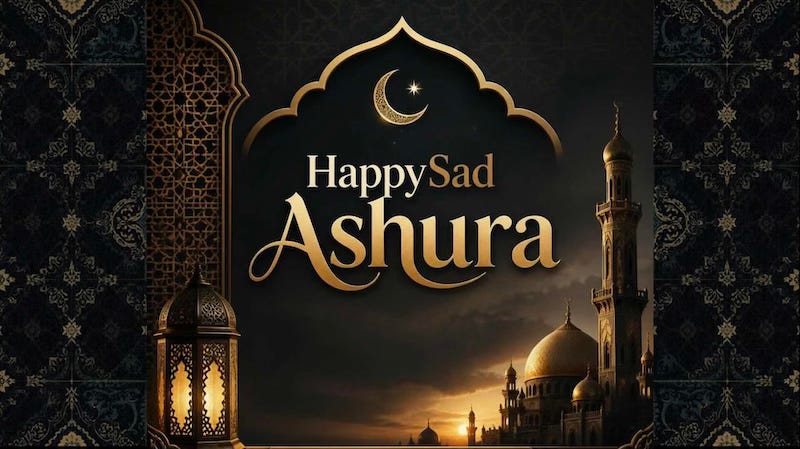
HappySad Ashura!
A nondenominational Muslim combines mourning and celebration

By Kevin Barrett, for Al-Andalus Tribune
Ten days ago, on the occasion of the Islamic New Year, I wrote:
The tenth of Muharram will mark the holiday of Ashura. For Shia Muslims Ashura is a festival of mourning, marking the martyrdom of Hussein at Karbala, while for Sunnis it is a complex amalgamation of mostly-celebratory activities and commemorations. The stark contrast between Shia mourning and Sunni celebration makes Ashura the one calendar date when the two interpretations of Islam seem to radically diverge.
But Ashura’s mourning/celebrating opposition actually overstates the difference. Sunnis, like Shias, mourn the death of Hussein at Karbala, and revile his killer, Yazid. But most Sunnis don’t ritually commemorate that tragedy on Ashura like the Shia do. (Actually, some Sunnis, especially Sufis, have made mourning for Hussein a part of their Ashura observance, but it’s not done much nowadays.)
Here in Morocco, people sometimes throw water on each other as a playful way of celebrating Ashura. They call it رش (splash) and imagine themselves blessing each other with holy Zamzam water from Mecca. The custom may also be linked to the Biblical/Quranic story of Moses parting the Red Sea, commemorated on Ashura—though in that case it was the bad guy, Pharaoh, who got splashed.
Ashura illustrates how Sunni-Shia differences, viewed superficially, can look huge: One celebrates, the other mourns. But beneath the surface, the two traditions are not so far apart, since all Muslims interpret the story of Hussein’s tragic martyrdom in roughly the same way, with the main difference being the degree of intensity of feeling.
Though Sunni and Shia Muslims agree that Hussein’s martyrdom was a terrible tragedy, their sharply divergent ways of observing Ashura tend to reinforce the sectarian divide. Sunnis celebrate Ashura as the day of God’s deliverance of Moses and his people by way of the miraculous parting and un-parting of the Red Sea. Other auspicious events said to have occurred on Ashura include Noah’s ark landing safely, God forgiving Adam and Eve, Yunus (Jonah) escaping the belly of the whale, and Yusuf (Joseph) being rescued from the well.
So how should we nondenominational Muslims observe Ashura? Should we mourn with the Shia or celebrate with the Sunni?
Though not a religious scholar, I came to Islam primarily by way of reason. I find Islam’s approach to God fully compatible with philosophy’s. (For details, see my conversation with Laurent Guyénot.) Since the open gates of ijtihad were what brought me to Islam, I’m going to keep thinking things through. And when I think through the issue of Ashura, it occurs to me that both the Shia and the Sunni get it half-right.
The Shia are right to remember and honor Imam Husayn’s sacrifice, “not merely a historical tragedy, but as the enduring criterion by which truth and falsehood continue to be measured.” Husayn stood up for truth against falsehood, justice against oppression, and right against wrong, heroically refusing to back down from his principles or give up because he was so massively outnumbered. His martyrdom is an inspiration not just for Shia people, and not just for Muslims, but for all humanity.
A Christian colleague of mine and former co-host at False Flag Weekly News, the late Presbyterian pastor John Shuck, was deeply moved by the story of Imam Husayn, and considered his pilgrimage to Karabala a high point of his life. Having just lost another wonderful and brilliant FFWN co-host, Cat McGuire, I am reminded to be grateful for God guiding me to this path that has crossed with such extraordinary people. Every Ashura, and every Arbaeen forty days later, I think of John Shuck at Karbala and am inspired by the example of that brave American Christian who wound up being disowned by his flock for following the example of Jesus and the prophets, peace and blessings on them all.
If the Shia are right to mourn Husayn, does that mean the Sunni are wrong to celebrate Musa’s delivery from slavery, among other triumphs, on Ashura? Allahu alim…but my best understanding is that Husayn’s martydom has a triumphant aspect as well as a mournful one, in that it has inspired millions of people across the generations to stand up for justice with their hands, tongues, and hearts. In the end, Husayn triumphs over his killer Yazid, because his example inspires people of truth and justice to stand against oppression and evil. So God’s plan for the triumph of good over evil, symbolized by the deliverance of Musa, Nuh, Yunus, and Yusuf, also applies to Husayn’s heroic sacrifice at Karbala.
We are witnessing this heroic, triumphant aspect of the Karbala tragedy today, as millions of courageous people, many but not all of them Shia Muslims, are making great strides toward liberating their lands from the genocidal Zionist-imperialist Dajjal. Iran’s David-vs.-Goliath victory over the combined might of Israel and the USA owes its inspiration to Husayn’s heroic sacrifice at Karbala. Ayatollah Ali Khamenei’s martyrdom, and the martyrdoms of so many others, were inspired by Karbala, and taken together are part of a larger pattern of good triumphing over evil. So celebration, as well as mourning, is indeed warranted!
As I observe Ashura here in Morocco—where people are celebrating their soccer team’s come-from-behind victory last night, as well as the deliverance of Musa, Nuh, Yunus, and Yusuf—I will embrace contradictory feelings, both celebratory and sorrowful, feeling gratitude to God for guiding me to His final revelation…while remembering the sacrifice of Imam Husayn, a tragedy that symbolizes spiritual and temporal triumph over both internal and external evils.
I hope you will write about Karbala with your own style of writing and thinking !!!!!
Ashura asks us not only what we remember, but what we have learned. Let’s spend this day in worship, gratitude, remembrance, and reflection. Ya Hu يا هو